Battery HOW works?
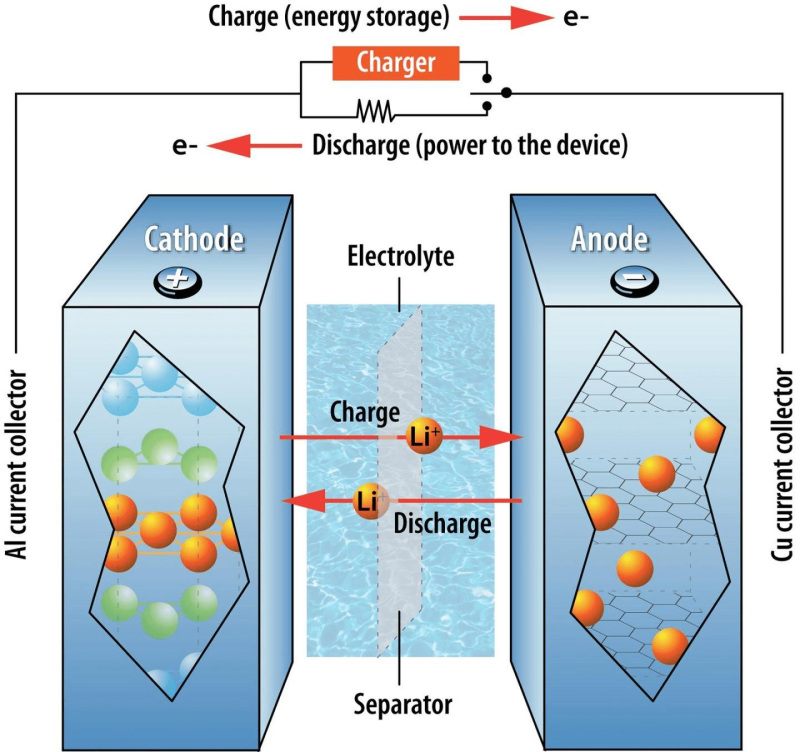
1. Cathode Material: One of the Key Factors Determining Battery Performance
The cathode can be understood as a “storage site” for lithium ions. Lithium cobalt oxide (LCO) and ternary lithium-ion materials are both cathode material systems.
Key factors affected: Operating voltage, capacity potential, energy density, thermal stability, and cost.
2. Anode Material: Works with the Cathode to Determine Lithium Storage Capacity
The anode can be understood as another “storage site” for lithium ions. Graphite is the most common anode material, while silicon-carbon (Si-C) anodes incorporate silicon into carbon-based materials to increase lithium storage capacity.
Key factors affected: Cell capacity potential, energy density, fast-charging performance, cycle life, expansion, and cost.
3. Electrolyte: Enables Lithium Ions to Move Between the Two Electrodes
The electrolyte acts as a pathway for lithium ions to move between the cathode and anode. Conventional lithium batteries typically use liquid electrolytes, while semi-solid-state batteries use electrolyte systems containing solid components, although some liquid may still remain.
Key factors affected: Ion transport, inter facial stability, temperature adaptability, safety risks, and manufacturing processes.
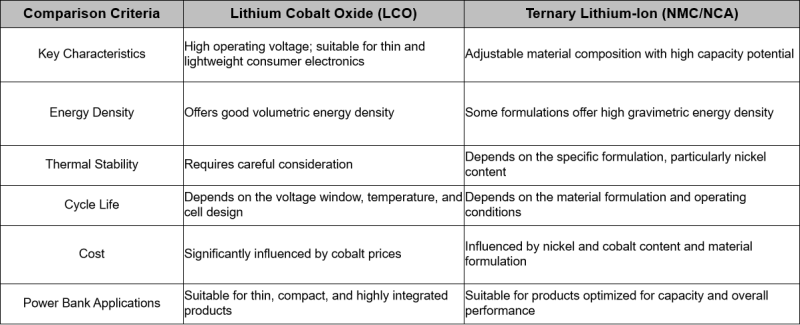
Different Cathode material:1. Cathode:LCO 2.Cathode:NMC/NCA
1.Cathode LCO:
Its advantage lies in high volumetric energy density, making it suitable for consumer electronics—such as smartphones—where space constraints are strict. For power banks, it offers the potential for thinner, more compact designs.
Key factors to consider include stability at high voltages, thermal safety, cycle life, and the cost of cobalt materials.
Brand rep.:ATL,Veken,Liwinon,CosMX
2.Cathode LCO:
Its advantage lies in high volumetric energy density, making it suitable for consumer electronics—such as smartphones—where space constraints are strict. For power banks, it offers the potential for thinner, more compact designs.
Key factors to consider include stability at high voltages, thermal safety, cycle life, and the cost of cobalt materials.
Brand rep.:ATL,Veken,Liwinon,CosMX
3.Cathode:LCO VS Cathode:NMC/NCA
Different Anode 1. Anode:Si-C 2. Anode:Graphite
1.Anode Si-C:
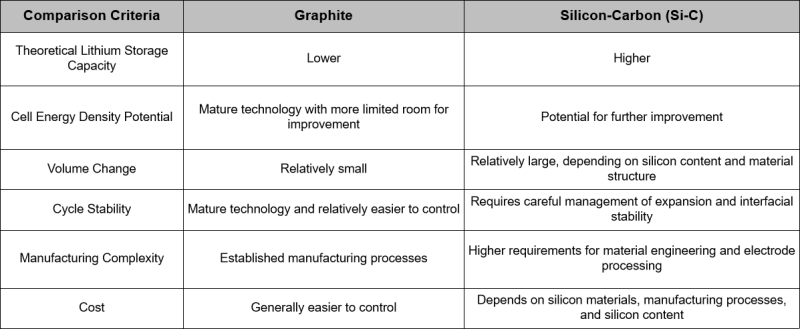
Incorporating silicon into carbon materials can enhance the theoretical lithium-storage capacity of the anode; consequently, with an optimal design, the capacity and energy density of the entire cell can be increased.
The challenge lies in the significant volume changes silicon undergoes during charge and discharge cycles, which can lead to electrode expansion, interfacial instability, and capacity fade; generally, the higher the silicon content, the more pronounced these engineering challenges become.
Brand rep: Guxin,Veken,LZL,Ganfeng,ATL
2.Anode:Graphite
Graphite is a widely used anode material in lithium-ion batteries. Its layered structure enables the storage and release of lithium ions during charge and discharge cycles. Thanks to mature manufacturing processes, graphite offers a favorable balance among capacity, cycle life, and cost.
Its primary limitation lies in its relatively low theoretical lithium-storage capacity compared to silicon-based materials. Consequently, relying solely on graphite as the anode imposes constraints on increasing cell capacity and energy density, particularly in applications with strict volume and weight requirements.
Brand rep: MARASONE
3.Anode:Si-C VS Anode:Graphite
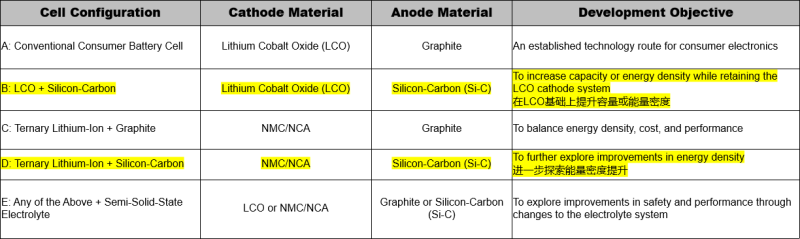
Cathode&Anode Different Combination(We use B&D )
The battery we used for options:
ATL: https://www.atlbattery.com/zh/
Veken: https://www.veken-tech.com/
LZL:http: //www.liyanzh.com/
GUXIN: https://guxin.cn/
EVE:https://www.evebattery.com/
Updating.....
Search from here
Get Free Quotes